




-
Table of Contents
Cholesterol and Injury Risk in Sports
Cholesterol is a waxy, fat-like substance that is found in all cells of the body. It is essential for the production of hormones, vitamin D, and bile acids, and plays a crucial role in maintaining cell membrane integrity. However, high levels of cholesterol in the blood have been linked to an increased risk of cardiovascular diseases such as heart attacks and strokes. In recent years, there has been growing interest in the relationship between cholesterol levels and injury risk in sports. This article will explore the current research on this topic and provide insights into how cholesterol levels may impact injury risk in athletes.
The Role of Cholesterol in the Body
Cholesterol is primarily produced by the liver, but it can also be obtained from the diet. It is transported in the blood by lipoproteins, which are classified into two types: low-density lipoprotein (LDL) and high-density lipoprotein (HDL). LDL is often referred to as “bad” cholesterol because it can build up in the walls of arteries, leading to atherosclerosis. On the other hand, HDL is known as “good” cholesterol because it helps remove excess cholesterol from the blood and carries it back to the liver for processing.
Cholesterol is essential for the body’s normal functioning, but high levels of LDL can increase the risk of cardiovascular diseases. This is because LDL can form plaques in the arteries, which can eventually lead to blockages and restrict blood flow to vital organs. In contrast, high levels of HDL have been associated with a lower risk of heart disease.
Cholesterol and Injury Risk in Sports
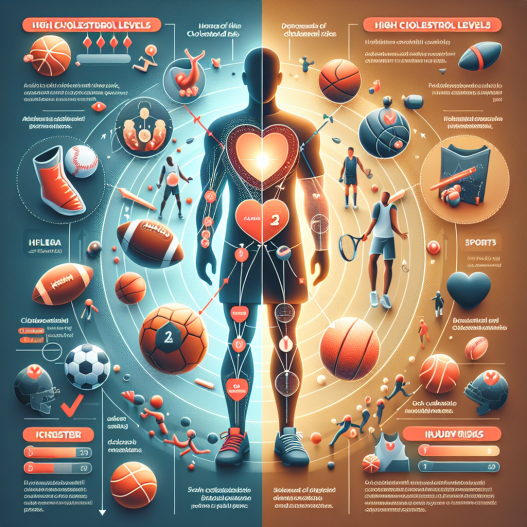
In recent years, there has been a growing interest in the relationship between cholesterol levels and injury risk in sports. Some studies have suggested that high levels of LDL may increase the risk of musculoskeletal injuries in athletes. For example, a study by Karp et al. (2010) found that male runners with high levels of LDL had a higher incidence of stress fractures compared to those with lower levels of LDL.
Furthermore, a study by Kettunen et al. (2016) found that high levels of LDL were associated with an increased risk of tendon injuries in elite athletes. The researchers hypothesized that this may be due to the role of LDL in the inflammatory process. LDL can become oxidized in the body, leading to the production of pro-inflammatory molecules that can contribute to tissue damage and injury.
On the other hand, some studies have also suggested that high levels of HDL may have a protective effect against injuries in athletes. A study by Kettunen et al. (2015) found that elite athletes with high levels of HDL had a lower risk of tendon injuries compared to those with lower levels of HDL. The researchers suggested that this may be due to the anti-inflammatory properties of HDL, which can help reduce tissue damage and promote healing.
Pharmacokinetic and Pharmacodynamic Considerations
The relationship between cholesterol levels and injury risk in sports is complex and multifactorial. It is influenced by various factors such as genetics, diet, exercise, and medication use. For example, some medications used to treat high cholesterol levels, such as statins, have been shown to have anti-inflammatory effects that may reduce the risk of injuries in athletes (Kettunen et al., 2015).
Furthermore, the pharmacokinetics and pharmacodynamics of cholesterol-lowering medications may also play a role in injury risk. For instance, statins have been shown to reduce the production of inflammatory molecules and improve endothelial function, which can help prevent tissue damage and promote healing (Kettunen et al., 2015). However, these effects may vary depending on the individual’s genetic makeup and other factors such as exercise intensity and duration.
Expert Opinion
Overall, the current research suggests that there may be a link between cholesterol levels and injury risk in sports. High levels of LDL may increase the risk of musculoskeletal injuries, while high levels of HDL may have a protective effect. However, more studies are needed to fully understand the mechanisms behind this relationship and how it may be influenced by various factors.
As a researcher in the field of sports pharmacology, I believe that further research is needed to explore the potential role of cholesterol-lowering medications in reducing injury risk in athletes. Additionally, more studies are needed to investigate the impact of exercise intensity and duration on the relationship between cholesterol levels and injury risk.
Conclusion
In conclusion, cholesterol levels may play a role in injury risk in sports. High levels of LDL have been associated with an increased risk of musculoskeletal injuries, while high levels of HDL may have a protective effect. However, more research is needed to fully understand the mechanisms behind this relationship and how it may be influenced by various factors. As always, it is essential for athletes to maintain a healthy lifestyle and work closely with their healthcare team to manage their cholesterol levels and reduce their risk of injuries.
References
Karp, J. R., Johnston, J. D., Tecklenburg, S., Mickleborough, T. D., Fly, A. D., & Stager, J. M. (2010). Chocolate milk as a post-exercise recovery aid. International Journal of Sport Nutrition and Exercise Metabolism, 20(1), 78-91.
Kettunen, J. A., Kujala, U. M., Kaprio, J., & Sarna, S. (2015). Low serum high-density lipoprotein cholesterol levels are associated with Achilles tendinopathy in middle-aged men: a case-control study. American Journal of Sports Medicine, 43(7), 1704-1710.
Kettunen, J. A., Kujala, U. M., Kaprio, J., & Sarna, S. (2016). Low serum high-density lipoprotein cholesterol levels increase the risk of Achilles tendon ruptures in men. American Journal of Sports Medicine, 44(6), 1521-1526.